Los Angeles Invented Modern Wellness. So Why Is New York Winning the Bathhouse Boom?
I’m still reflecting on my trip to LA and Palm Springs. Where is the Cali new gen bath houses?
For a city that practically invented modern wellness culture, Los Angeles has been surprisingly absent from the contemporary bathhouse boom.
This is, after all, the city that taught the world how to aestheticise self-improvement. Long before wellness became a trillion-dollar global industry, Los Angeles had already transformed beauty, fitness and therapy into cultural identity systems. Nail salons exploded across California in the 1960s and 70s through Korean and Vietnamese entrepreneurship. Yoga became lifestyle branding here. Pilates evolved from rehabilitation into luxury ritual here. Green juice, adaptogens, infrared saunas, lymphatic drainage, “clean beauty,” holistic facials, even therapy as a socially acceptable part of daily life — all roads somehow lead back to California. Everything new and weird starts in LA and ends up in London a decade later. I remember having mushroom drinks at Gratitude like 15 years ago and now you can buy them in Sainsbury’s.
LA has spent decades selling the fantasy of becoming a better version of yourself.
Which is why it feels strange that the new social bathhouse movement — arguably the biggest shift in wellness hospitality right now — is currently being dominated by New York.
Over the last three years, New York has entered what some investors and media outlets are now openly calling the “sauna wars.”
The leading players are scaling quickly. Othership — the Toronto-born social sauna and ice bath concept — recently raised $11.3 million to accelerate its US expansion, with additional New York locations already underway. Founded by Robbie Bent and backed by investors including Rocana Ventures and Shawn Mendes, Othership has become the poster child for a new category sitting somewhere between wellness startup, emotional support group and immersive nightlife replacement. Its model blends breathwork, sauna rituals, guided emotional experiences and cold plunges inside phone-free, alcohol-free social environments.
Meanwhile the first new gen bath experience I ever had was Bathhouse, and the Brooklyn-founded luxury bathhouse concept known for its industrial “Dune”-like aesthetic recently raised $35 million led by Imaginary Ventures as it prepares to expand into Los Angeles, Chicago and Nashville. Investors are clearly betting that communal bathing is no longer niche wellness behaviour but an entirely new hospitality category.
Then there is AIRE Ancient Baths which was somewhere between the traditional and the new. They’re perhaps the most globally sophisticated operator in the category, whose candlelit Roman-inspired thermal spaces now stretch across New York, London, Barcelona, Copenhagen and Chicago. Earlier this year, AIRE partnered with strategic investor Khemia to accelerate international expansion, while simultaneously preparing its first Los Angeles location.
Suddenly, bathhouses are no longer fringe wellness spaces. They are venture-backed cultural infrastructure.
And yet despite all this momentum, much of the current movement still feels unmistakably East Coast in tone.
New York bathhouse culture has developed a very specific masculine energy. Hyper-optimised. Performance-oriented. Quantified. Cold plunges measured to exact temperatures. Sauna endurance as discipline. Recovery framed almost like athletic achievement. The aesthetics often mirror this mentality too: dark concrete interiors, brutalist architecture, ambient techno soundtracks and startup-adjacent branding that feels halfway between luxury gym and members club.
Even the language surrounding many of these spaces reveals the shift. Wellness is no longer framed around softness or pleasure but around resilience, optimisation and nervous-system performance. You are not simply relaxing anymore; you are “building tolerance,” “unlocking dopamine” or “training mental strength.”
Honestly I am sick of overhearing men in the ice baths telling each other you MUST STAY IN FOR TWO MINUTES OTHERWISE IT WONT WORK while side eyeing the women who dip in for ten or twenty seconds. There is no universal knowledge within these communities on what cold water immersion does to women who have a completely different response.
“Men and women differ significantly in how the autonomic nervous system and thermoregulatory processes respond to cold. Women’s resting metabolic rate and core temperature regulation are influenced by estrogen and progesterone fluctuations across the menstrual cycle.
Research shows that women generally vasoconstrict faster (reducing blood flow to the skin) and experience greater drops in core temperature during immersion, especially in the luteal phase when progesterone is high. This makes us more sensitive to cold stress.
So, when women plunge into near-ice temperatures, the neuroendocrine system responds with a sharp spike in sympathetic activity and cortisol. Over time, that can disrupt menstrual regularity, blunt thyroid function, and impair recovery.”
In contrast, immersions at moderately cold temperatures—around 15°C (59°F)—produce a more balanced response: you still get the release of norepinephrine (for focus, alertness, and mood), mild shivering thermogenesis (for metabolic boost), and increased mitochondrial biogenesis, without tipping into chronic stress territory.”
To be clear, these New York spaces are extraordinarily well executed. In particular, they have brilliantly understood how loneliness, sobriety and emotional wellness are converging into a new social category. But much of the sector still feels rooted in a particularly masculine vision of recovery culture.
Othership is the most California in its design.
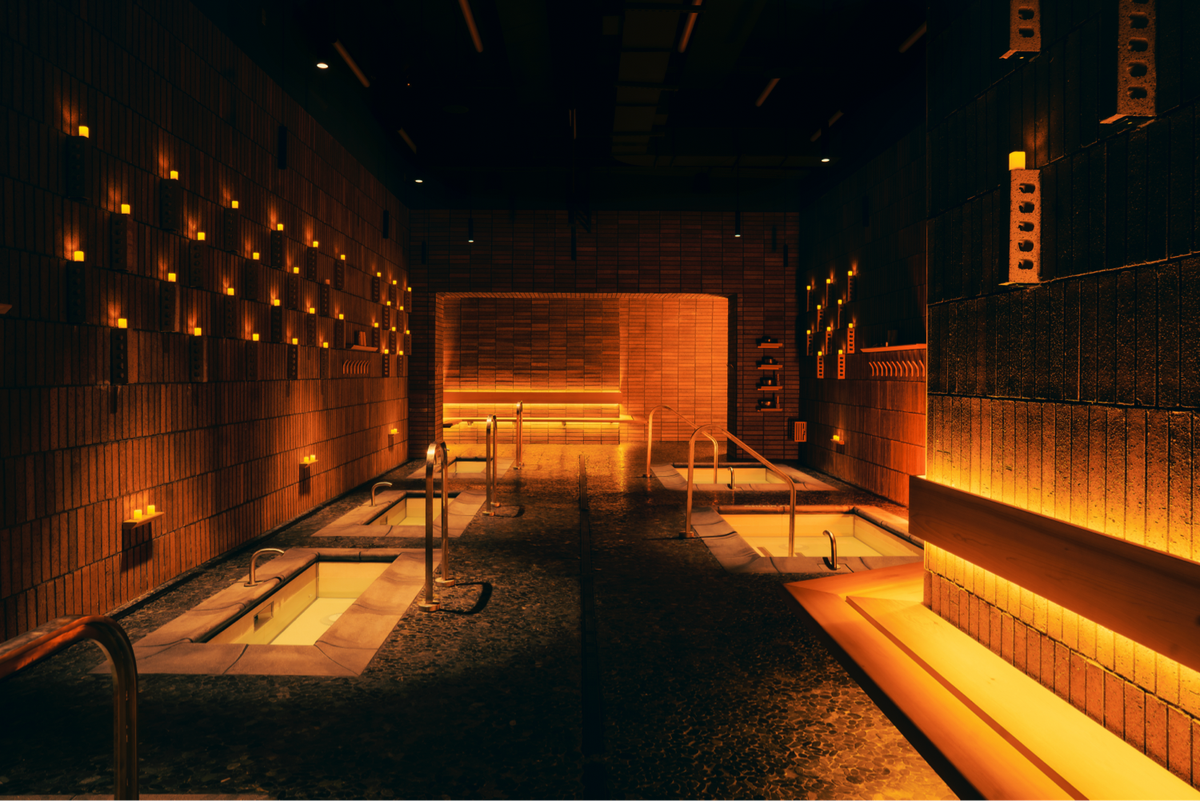
If there are going to be East Coast transplants to LA then Othership already feels aesthetically closer to Los Angeles than New York. The interiors lean heavily into that softened California desert language — warm adobe tones, sculptural curves, low amber lighting, palo santo-and-creosote style incense, the kind of scent profile that immediately evokes Topanga, Joshua Tree or an expensive Venice Beach candle store. Even the emotional openness of the experience — breathwork, vulnerability, crying in saunas — feels deeply tied to West Coast therapy culture. But layered beneath all that softness is still a very tech-bro framework of optimisation, nervous-system hacking and self-performance. Bathhouse, by contrast, feels much more urban and East Coast in its identity: concrete, steel, dark pools and industrial architecture that would fit naturally into Silver Lake or Echo Park’s design crowd — creative directors, architects, DJs and fashion people looking for an A24 version of ancient Rome.
But LA could develop a style all of its own.
However LA does not need to imitate New York’s version of bathhouse culture. In many ways, it already possesses a completely different blueprint — one that has quietly existed for decades inside Koreatown.
One of the most transformative bathing experiences I’ve had anywhere in the world was at Olympic Spa in Los Angeles. Not because it felt luxurious in the contemporary wellness sense, but because it didn’t. Elderly Korean women scrubbed bodies with the confidence and rhythm of people participating in a ritual embedded into everyday life rather than a trend cycle. Women moved communally through heat, steam and water with almost complete emotional neutrality toward nudity or performance.
Because Korean spas still retain something many modern wellness spaces have lost: practicality. They are not designed around aspiration. They are designed around repetition. Around maintenance. Around community care. People go weekly, not occasionally. Bathing is integrated into life rather than positioned as an elite self-improvement event.
And this is where LA could genuinely reclaim leadership.
The city already has the behavioural infrastructure for a more feminine, emotionally intelligent bathhouse culture. Women in Los Angeles already spend enormous amounts of time and money moving between facials, Pilates, acupuncture, bodywork, saunas and beauty treatments. The ecosystem exists. What’s missing is a contemporary communal space that brings those rituals together architecturally.
Water, water, not everywhere
Of course, any serious conversation about bathhouse culture in Los Angeles now comes with an unavoidable tension: water itself. This is a city built on one of the most ambitious and controversial water engineering projects in American history. LA’s entire mythology — the lawns, pools, fountains, spas and endless fantasy of abundance — has always existed in negotiation with drought. Wellness culture here has historically been deeply individualised partly because private water luxury became embedded into the architecture of success itself: the backyard pool, the hot tub in the hills, the cold plunge at home. But communal bathing actually offers a more efficient and potentially more sustainable model than thousands of isolated private wellness installations spread across the city. As California continues tightening environmental and zoning regulations around water use, energy consumption and development, the next generation of LA bathhouses will likely need to position themselves not simply as luxury spaces, but as thoughtful civic infrastructure — places that rethink how urban communities gather around water collectively rather than privately. In a strange way, the future of bathing in Los Angeles may depend on making wellness feel less extractive and more communal again.
A future LA Bathhouse
The future iconic LA bathhouse probably looks very different from New York’s current social sauna scene. Less biohacking bunker. More sanctuary.
I imagine something that merges Korean day spas, old Hollywood glamour, Japanese bathing rituals, Mexican spa culture and Palm Springs desert modernism. Warm light instead of darkness. Olive trees and mineral pools. Outdoor courtyards. Quiet social spaces. Restaurants serving broths and tea rather than protein shakes. Places designed for lingering rather than optimisation.
Not wellness as punishment. Wellness as atmosphere.
Because as I keep banging on as part of my bathing brand 39BC
Historically, bathing was never simply about hygiene or recovery. Roman thermae functioned as political and social infrastructure. Hammams were communal gathering spaces. Onsens carried spiritual significance. Korean bathhouses became intergenerational rituals. Humans have always gathered around warm water because it creates a temporary softening of social barriers.
The irony is that LA already invented the emotional language modern wellness brands now monetise globally. It just hasn’t yet produced the defining bathhouse brand to match it.
But given the amount of capital now pouring into the category, that probably won’t remain true for long.
Current Los Angeles Bathhouses & Water Ritual Spaces You Can Try
- Olympic Spa — The Koreatown institution famous for its brutally effective Korean body scrubs, pink robes and no-frills women-only communal bathing culture.
- Wi Spa — The 24-hour Korean spa that quietly became one of LA’s most democratic social spaces, where students, beauty girls, exhausted creatives and entire families coexist in steam rooms.
- Beverly Hot Springs — Built around a natural geothermal spring discovered during oil drilling in 1930, this is one of the few remaining natural hot spring spas in central Los Angeles.
- Descanso Day Spa — A quietly beloved Japanese-inspired day spa in Los Angeles known for its calming gardens, soaking rituals and old-school approach to relaxation.
- Glen Ivy Hot Springs — Open since the 1860s, this inland Southern California mineral spring resort became a blueprint for California’s spa and soaking culture long before modern wellness existed.
- The Spa at Séc-he — Palm Springs’ newest luxury thermal destination, built around sacred Agua Caliente hot mineral springs used for healing by the Cahuilla people for centuries.
- Century Day & Night Spa — A Koreatown classic where generations of LA women have treated communal bathing as weekly maintenance rather than aspirational wellness.
- Burke Williams — The polished Californian day spa chain that helped mainstream luxury self-care culture in LA throughout the 1990s and 2000s.
- Sea Mountain Inn & Spa — Desert hot spring culture at its most eccentric and old California, where mineral soaking meets faded hedonism.
- Two Bunch Palms — The legendary Desert Hot Springs property long associated with old Hollywood, seekers, mystics and California’s long-standing obsession with mineral water healing.